

Combining brackets and aligners in the same case
Fixed appliances or aligners is often presented as a choice. In practice, some cases are solved faster and more cleanly with both, each one doing the part it does best. The condition is that they are planned together: the aligner has to be designed knowing that brackets will be working on part of the arch.
A case where aligners alone would be slow
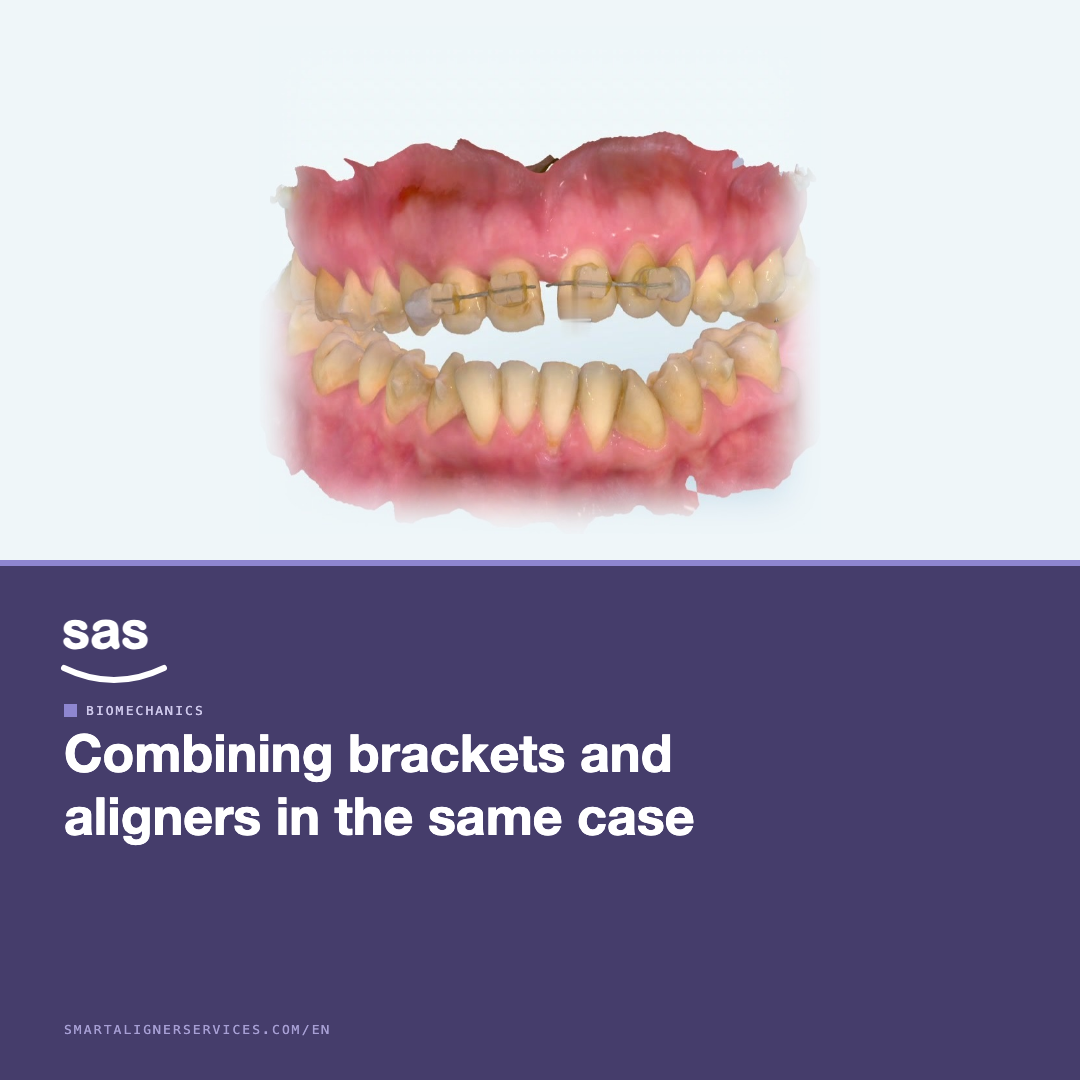
An adult patient has just had a maxillary expansion with MARPE, anchored on six miniscrews. Once the midpalatal suture opens, a wide diastema appears between 11 and 21, and the incisors start to drift. Closing that space with aligners alone is possible, and we have described how to close an interincisal diastema after MARPE with a carefully sequenced aligner approach. But in some cases it is a long and less predictable movement, and the time it costs does not pay off.
The criterion: efficiency, not preference
The decision to move a segment to fixed appliances has nothing to do with preferring one system over the other. It is about efficiency. When one specific movement becomes slow or unpredictable with the aligner, handing only that segment to brackets saves time without giving up the rest of the aligner plan. Here, brackets go on the teeth involved in the closure, and interradicular miniscrews between the upper anterior teeth anchor the mechanics.
What makes it work: a segmented aligner
The two systems can only coexist if the aligner is designed for it. The key instruction to the CAD designer is to trim and segment the aligner at the level of the teeth that will be moved with brackets. The aligner keeps holding the rest of the arch, and the fixed segment works freely where it needs to, without the plastic getting in the way. In many of these cases there is no room for button cut-outs, so segmentation is the practical route.
This only happens if it is asked for. A designer who receives a standard prescription will produce a standard aligner covering every tooth.
Timing the two systems together
There is no exact formula for timing. The useful request is that the space closure is staged so the fixed segment and the aligner progress in coordination, moving slowly and accepting that a small adjustment may be needed at the end. Remote monitoring helps a lot in this phase: the patient sends photographs and you follow the closure without bringing them in at every step.
When it is not worth it
A hybrid approach adds chair time, bonding and a second mechanic to supervise. It makes sense when one movement is clearly holding back the whole case. If the aligner can handle the movement within a reasonable time, keep it simple. The question is always which tool delivers that specific movement best, not how to avoid one of them.
The principle behind it
Combining brackets and aligners is not a patch for a plan that failed. It is the recognition that each movement has its best tool. What makes the combination possible is planning: a segmented aligner, skeletal anchorage where it is needed and a coordinated closure. Asked for clearly, a case that would drag on with aligners alone can be finished cleanly.
Want to learn to combine fixed appliances and aligners within one plan? The SAS Method at Smart Aligner Services teaches advanced aligner biomechanics and planning, peer to peer, from orthodontist to orthodontist.

How to write a prescription your CAD designer can follow

Infrazygomatic miniscrews to distalise a Class II with clear aligners

IPR with clear aligners: when it makes sense and how much to do

