

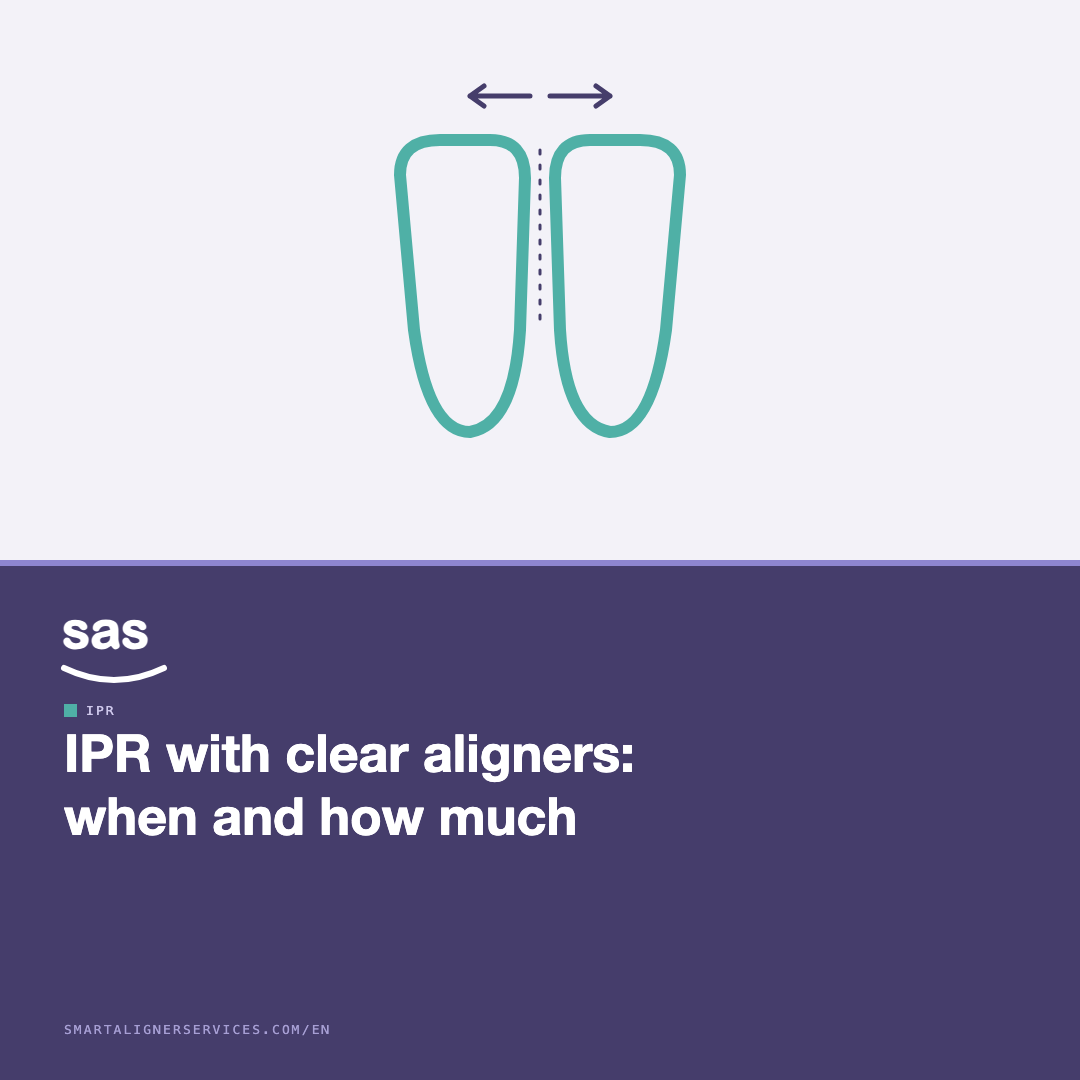
IPR with clear aligners: when it makes sense and how much to do
Interproximal reduction (IPR) is one of the most common ways to gain space in clear aligner treatment, and one of the easiest to misuse. Done with a reason, at the right stage and in the right amount, it solves crowding without expanding or proclining beyond what the case tolerates. Done by default, it removes enamel that was not needed.
What IPR is for
IPR removes a small amount of enamel from the proximal surfaces to create space or improve tooth shape. Its main uses are:
– Mild to moderate crowding, when the alternative would be more expansion or proclination than the periodontium and the profile allow.
– Tooth size discrepancies, such as a Bolton discrepancy, to coordinate both arches.
– Shape and contacts: reshaping triangular teeth and reducing the risk of black triangles after alignment.
It is a source of space to weigh against the others (expansion, proclination, distalisation, extractions), not an automatic first choice.
When not to do it
IPR is a poor option with high caries risk, poor hygiene, small or very rounded teeth with little proximal enamel, or extensive restorations where the contact is not natural enamel. In those cases another source of space usually makes more sense.
How much
The amount depends on the enamel available on that tooth, not on the space the setup would like to find. The usual reference is not to remove more than about half of the proximal enamel thickness, which on lower incisors leaves very little margin. That is why the total planned per contact should be checked tooth by tooth, and why large amounts concentrated on a few contacts are a warning sign in a setup.
When: staging matters as much as the amount
IPR should be done when the contact is accessible and shortly before the tooth needs that space. On rotated or overlapped teeth, align first and reduce later: stripping a contact you cannot reach properly gives inaccurate results. Planning all the IPR at aligner one, by default, is rarely the best sequence.
Doing it accurately
Measure the space with gauges before and after, record what was actually done, keep the contact anatomy rounded and finish with polishing and fluoride. If the real amount differs from the planned one, the plan will drift, so accuracy is not a detail.
Check it in the setup
Before approving, look at where the setup places IPR, how much per contact and at which stage, and ask whether that space could come from somewhere better. A well-planned IPR is distributed, justified and timed. A default one is just enamel lost.
Want to decide where space should come from with biomechanical judgement? Explore how the SAS Method teaches advanced aligner planning at Smart Aligner Services, peer to peer, from orthodontist to orthodontist.
Combining brackets and aligners in the same case

How to write a prescription your CAD designer can follow

Infrazygomatic miniscrews to distalise a Class II with clear aligners

