

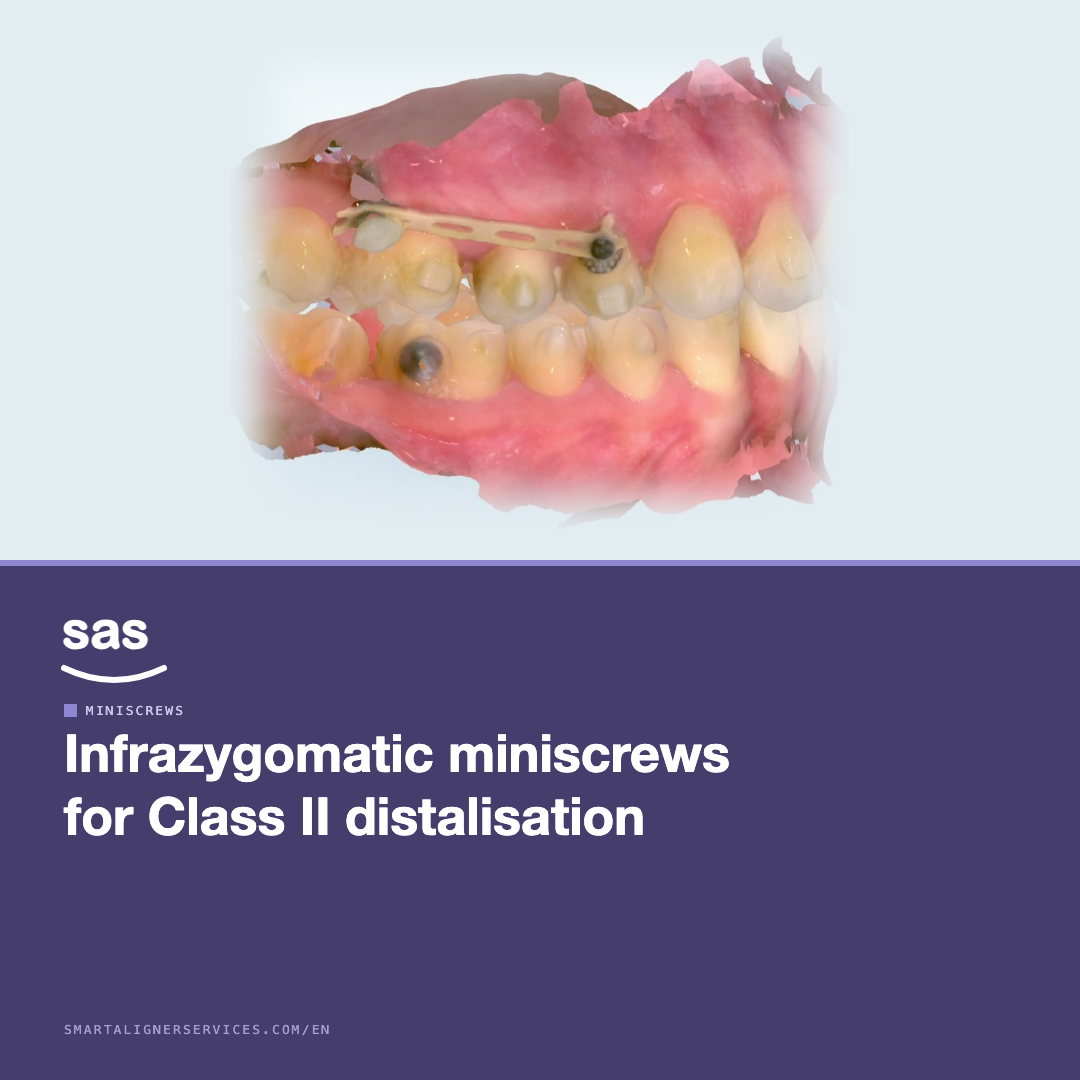
Infrazygomatic miniscrews to distalise a Class II with clear aligners
This case came from another practice and was stuck: a skeletal Class II that had been treated with intermaxillary elastics, leaving very proclined incisors. The problem was structural. More elastics would only have proclined the front further. What the case needed was different: distalise without mesialising the lower arch and retract those incisors, and that takes skeletal anchorage.
Why the elastics had reached their limit
Class II elastics have a component that, in a case already proclined, works against you: the more you pull, the further forward the front goes. Recognising that the tool the case arrived with is part of the problem is the first step. From there, the question is no longer how to pull harder, but where to anchor from.
The infrazygomatic miniscrew: distalise and intrude at once
We chose miniscrews in the infrazygomatic crest (IZC), one of the most comfortable sites for this kind of case. They offer a double advantage: besides anchoring the distalisation, depending on where they are placed they let you plan molar intrusion. We placed them bilaterally, and after about 20 aligners the upper arch is distalising, the molars are intruding and the anterior segment is retracting en bloc.
Molar intrusion that solves part of the Class II
This is the detail that gives the mechanics its value. Intruding the molars and removing the premolar contacts allows the mandible to autorotate. That autorotation closes the open bite and, by repositioning the mandible, corrects part of the Class II, even in an adult patient. It is the skeletal anchorage guiding the maxilla that makes it possible. If the open bite is the main problem rather than the Class II, we described selective posterior intrusion with miniscrews in a separate case.
Elastic chain and a one-half pattern for predictability
The elastic chain is changed every 10 to 12 weeks with a moderate activation; it does not need to be strong, because its job is to guide the maxilla steadily from a stable anchor. Meanwhile, the aligner runs a one-half distalisation pattern, and that combination is what brings predictability and lets the lower incisors move well. The principle: when elastics are pushing a case in the wrong direction, IZC anchorage lets you distalise, intrude and autorotate in a controlled way.
Want to plan distalisation and intrusion with infrazygomatic anchorage and clear aligners? Explore how the SAS Method teaches advanced aligner biomechanics at Smart Aligner Services, peer to peer, from orthodontist to orthodontist.
Combining brackets and aligners in the same case

How to write a prescription your CAD designer can follow

IPR with clear aligners: when it makes sense and how much to do

