

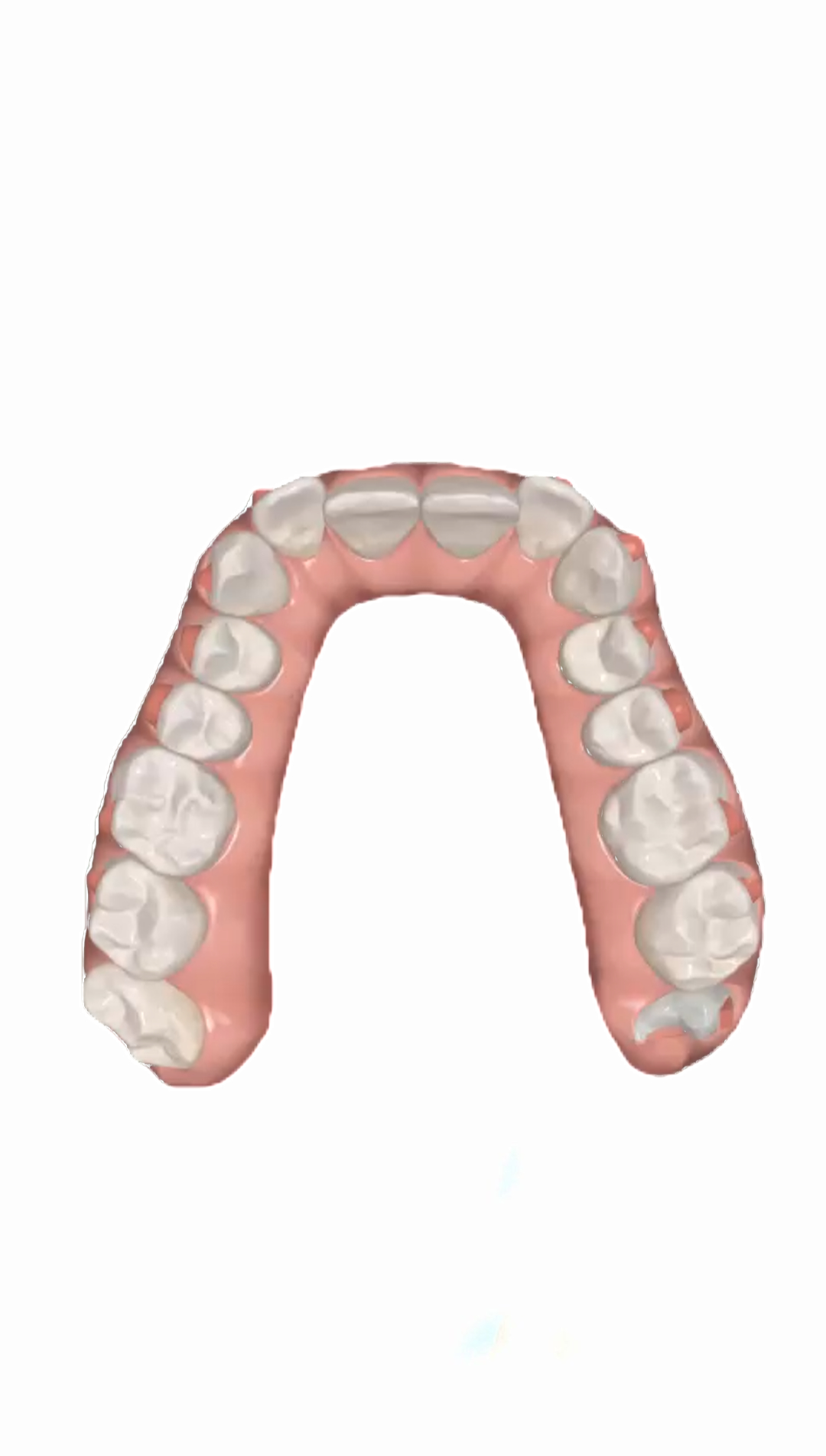
How to avoid interferences in your digitalizations
Achieving effective distalization in a single aligner package is possible, but it depends almost entirely on having identified and resolved interferences before starting. The most frequent one (and the most commonly overlooked) has to do with the most distal molar.
If that molar represents an interference and no action is taken before digitalizing the rest of the arch, the movement is blocked from the start.
The distal molar: identify it first, then act
The first step is to assess whether the most distal molar represents an interference for the patient’s distalization.
If it does, it must be distalized 1 mm during the first four to five aligners, and that instruction must be communicated explicitly to the technician. This is not an accessory movement: it is the condition that allows the rest of the sequence to work.
Once cleared, the technician is instructed to intrude it 1 mm at maximum velocity. Working at that speed in this phase reduces flexion with the adjacent tooth and makes the intrusion far more predictable.
The final position of the molar is non-negotiable
The CAD designer must be clear that this position, once achieved, is the final treatment position.
This is not a provisional movement or a preparatory phase to be corrected later. If the technician does not understand this, they may plan subsequent movements on that tooth that undo what was achieved in the initial phases.
The right attachment and vertical control
For distalization to express correctly, the molar must carry an optimized attachment for that movement (ideally multiplanar).
And there is a detail that is frequently overlooked: it must be confirmed that no vertical movements exist on the teeth mesial to the molar being worked. Any vertical movement in that zone creates a secondary interference that compromises the outcome of the entire sequence.
An unresolved interference invalidates the entire plan
The most careful digitalization is worthless if the distal molar is blocking the movement from the start.
When the interference is identified, addressed before planning the rest, and the vertical environment of the mesial teeth is controlled, distalization occurs within a single aligner package and without the need for subsequent corrections.
If you want to learn how to anticipate this type of interference and resolve it with your own clinical judgment, you can learn more about it in the SAS Method.

Correcting a gummy smile with miniscrews and clear aligners
Clear aligner treatment planning: how it works
Lower distalisation with miniscrews in Class III


