Closing extraction spaces with reciprocal anchorage, step by step
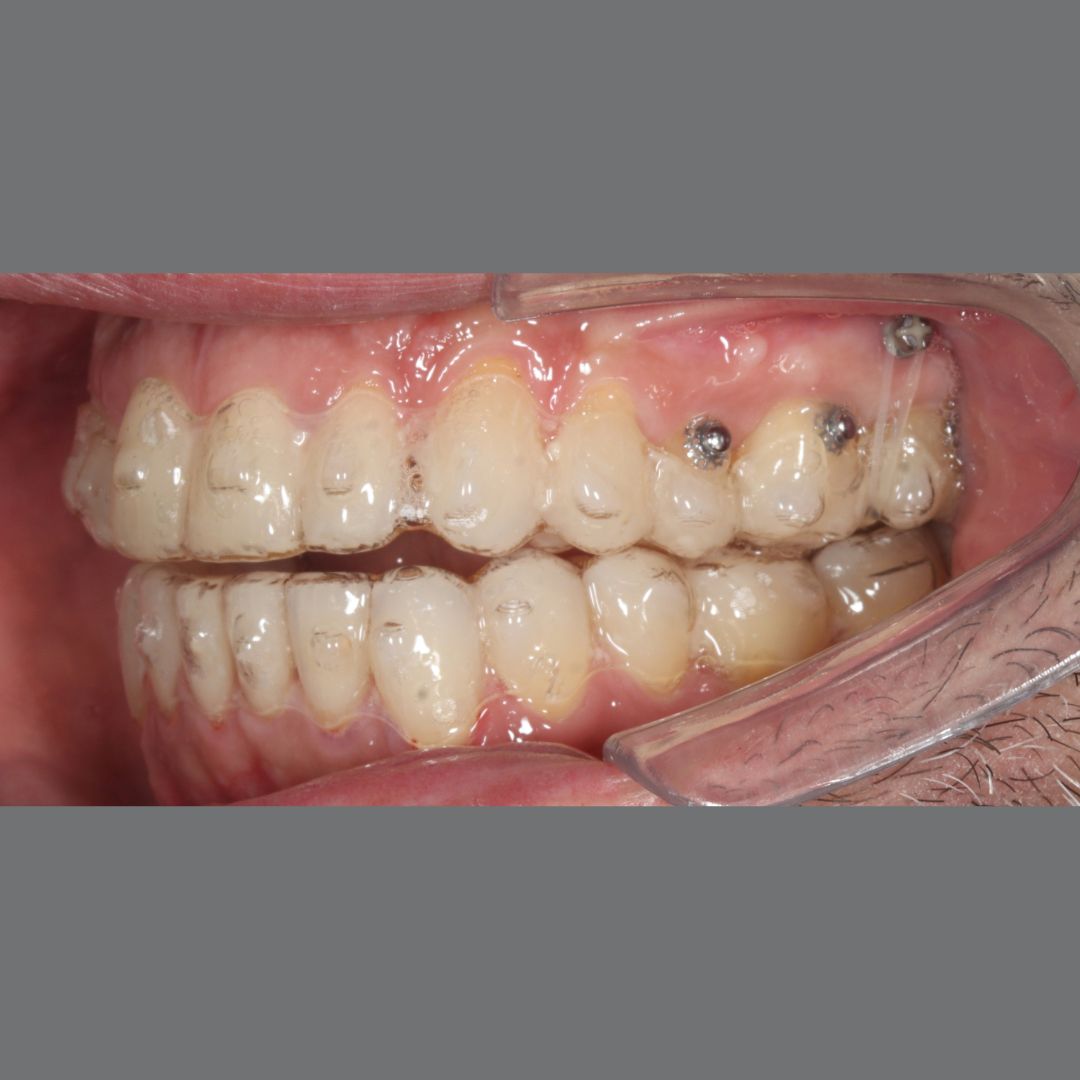
Closing extraction spaces with aligners is one of the scenarios where improvisation shows the most, and where the lack of a clear protocol shows even more. In Class II or Class III cases requiring full correction, where a direct staging would be complex, the key is sequencing the movement with reciprocal-anchorage logic that lets you advance with control at every phase.
The most common mistake is trying to close the space and retract the incisors at the same time, before the conditions for that movement to be stable have even been set.
Capture the third molars as anchorage from day one
If the third molars are present, they need to be in the system from the start.
Leaving them out means giving up a posterior anchorage source that can be decisive in extraction cases. Capturing them from the beginning lets you use them as support during the closing phases and stops the posterior segment from mesialising in ways you didn’t plan for.
Canine uprighting and incisor tipping: two movements at once
The first phase works canine uprighting at the same time as incisor tipping.
That simultaneity is not incidental. It creates reciprocal-anchorage biomechanics, similar to placing a spring between canines and laterals: each movement supports and offsets the other. The system advances without needing skeletal anchorage, because the teeth anchor each other.
Throughout this phase, molars and premolars stay immovable, with one exception in the lower arch, where a slight movement is allowed to flatten the curve of Spee. That control over the posterior segment is exactly what lets the anterior closure progress with precision.
Retrusion, only once the canines are in their final position
This is where sequencing errors happen most, by rushing a phase before its time.
Retracting the incisors only makes sense once the canines are already in their final position. Doing it earlier reduces the anchorage available and compromises control of the closure. That final position is left with the space held (an explicit instruction to the technician) and full anchorage at molar level.
Finishing the closure: posterior mesialisation or canine distalisation
Once the canines are in Class I and the extraction space is under control, there are two ways to finish the closure.
In most cases there’s a slight spontaneous mesialisation of the posterior segment that helps close the residual space. In others, where the canine still has room to move, a final distalisation of that tooth is enough to complete it. The choice between the two isn’t arbitrary: it depends on the real clinical situation at the end of that first phase.
The biomechanics aren’t complex when the order is right
Closing extraction spaces with aligners doesn’t need auxiliary resources in most cases. It needs the sequence respected: capture the third molars, work canines and incisors together with reciprocal anchorage, keep the posterior segment still, and retract only once the anterior anchorage is consolidated.
When that order is respected, the result is predictable and the number of refinements needed drops significantly.
—
Want to plan extraction-space closures with your own clinical judgement? Explore how the SAS Method teaches advanced aligner biomechanics at Smart Aligner Services.
Attachments in clear aligners: what they do and which types matter
Using a Bolton discrepancy to simplify extraction cases
Clear aligner training for orthodontists: what actually moves the needle