The sandwich technique: solving severe crowding without stripping, extractions or TADs
When a severe crowding case comes in, the first options that come to mind are almost always the same: stripping, extractions or TADs. In some patients, whether for periodontal reasons, patient preference, or both, none of those is viable or desirable. The sandwich technique is the alternative when the crowding has to be resolved without reaching for any of them.
It is not a simple technique to plan, but the results justify the effort when the case is well selected.
What it involves: coordinated distalisation of all four quadrants
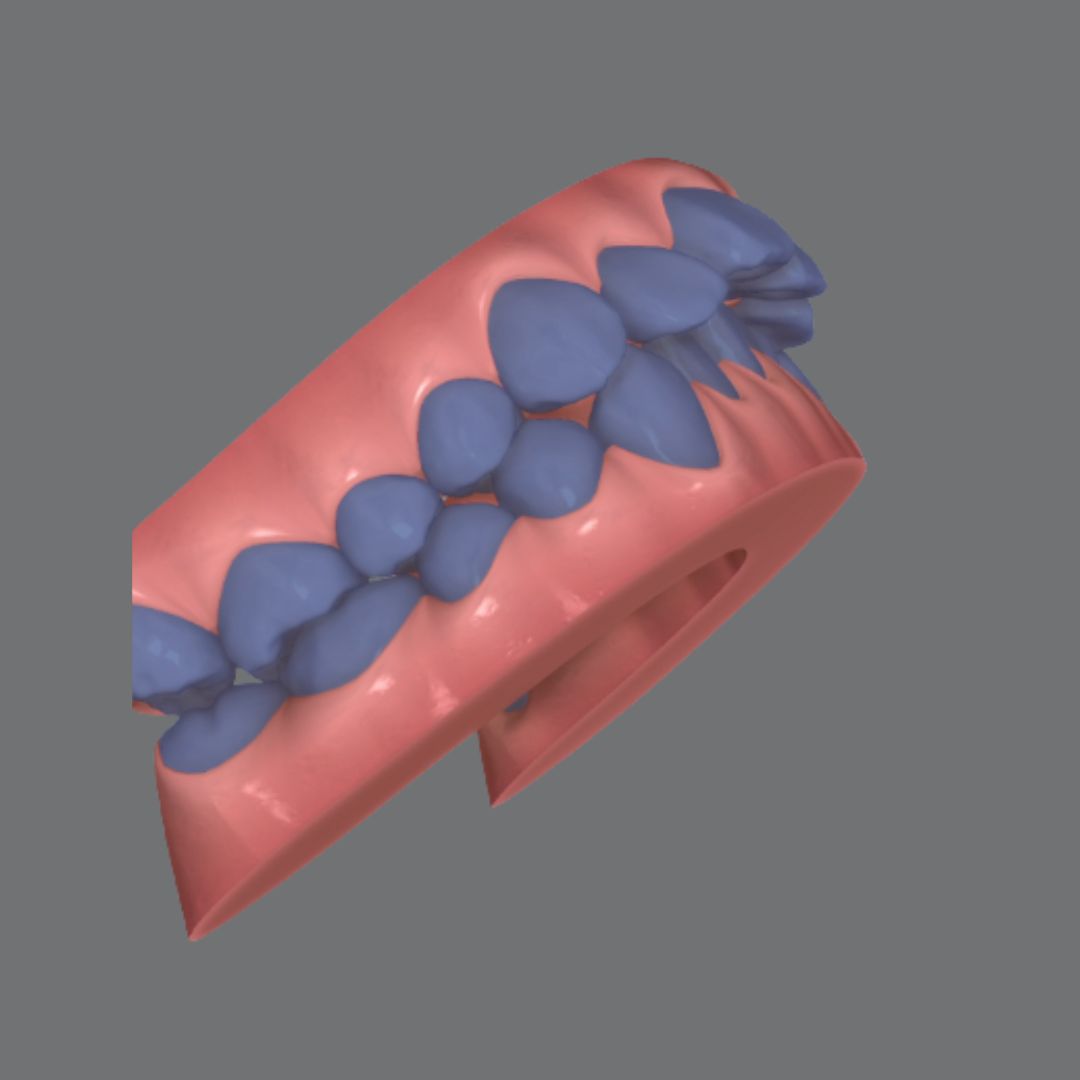
The sandwich technique consists of distalising all four quadrants simultaneously and in a coordinated way.
The usual range is between 1 and just over 1 mm of distalisation per quadrant. That amount, combined with moderate expansion, is normally enough to resolve the crowding without over-proclining the incisors. In fact, one of the most characteristic outcomes of this technique is that the teeth end up in a more retrusive position than where they started, which is particularly useful in cases where anterior proclination is contraindicated.
The detail that decides success: coordination between the arches
Distalising four quadrants at the same time opens a lot of fronts at once, and the biggest risk is that occlusal interferences appear between the upper and lower arch during the process.
That is why transverse coordination between both arches has to be watched throughout the whole treatment, not only at the end. At every stage you need to confirm that no premature contacts or blocks are appearing that could deflect the mechanics or slow the movement down.
There is also a sequencing rule worth respecting every time: the upper arch is distalised slightly ahead of the lower one. That small time lag is what stops the two arches from locking each other in the intermediate stages.
Three conditions that must hold at every stage
During planning and monitoring of these cases, there are three things you cannot afford to overlook.
The first is that there has to be real distalisation in the posterior segment of all four quadrants, not just one or two. The second is controlled anterior projection accompanying that distalisation without overshooting it. The third is that no intermediate stage should show interferences between the arches that compromise the coordination of the whole system.
When any one of these three fails, the treatment stretches out and the refinements you were trying to avoid show up anyway.
Longer cases, but with results other options cannot match
This technique has one clear limitation: treatment plans run longer than extraction or stripping cases, precisely because every possible interference has to be managed carefully across a sequence with many simultaneous movements.
But that extra time is the price for something the other options do not offer: resolving severe crowding with a deep bite, a pronounced curve of Spee and constriction, without pushing teeth past the cortical plate, without stripping and without any kind of surgical procedure. In the right patient, it is an option worth weighing before assuming extractions are the only way out.
Want to plan and manage sandwich-technique cases with your own clinical judgement? Explore how the SAS Method teaches advanced aligner biomechanics at Smart Aligner Services.
Attachments in clear aligners: what they do and which types matter
Using a Bolton discrepancy to simplify extraction cases
Clear aligner training for orthodontists: what actually moves the needle