Molar uprighting in a single aligner package
Molar uprighting produces more misfits than it should. Not because the movement is inherently difficult, but because it is almost always planned with the wrong tooth at the center of the mechanics.
The molar being uprighted is not the starting point. The tooth next to it is.
With the right anchorage logic, uprighting becomes a predictable coronal movement that can be completed in a single aligner package, without refinements.
The mesial tooth comes first
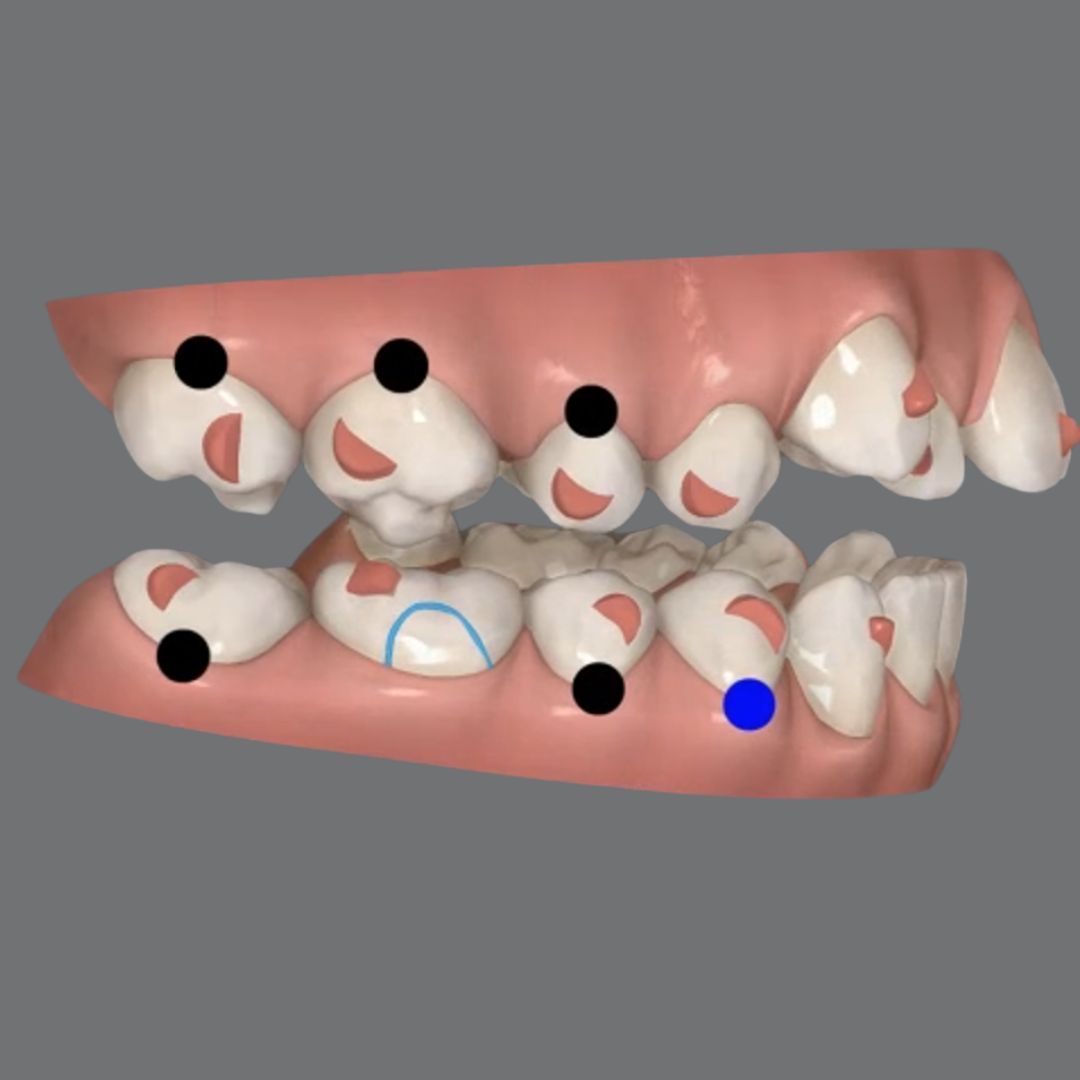
Before programming any movement on the molar itself, the tooth immediately mesial to it must be treated as immovable for the entire treatment.
This is the anchorage on which all the mechanics depend. Any unintended movement in that tooth undermines the outcome. To secure it properly, it must carry a hook and, where possible, an optimized attachment (a vertical attachment serves the purpose when no optimized option is available).
The molar moves only at the crown
Once anchorage is secured, the molar is adjusted using tip and torque controls, with one clear objective: bring the crown to its ideal final position without moving the apex.
This is a purely coronal movement, and that is precisely what makes it predictable. The system is not simultaneously trying to manage the root and tip the crown. That tooth must also carry an optimized attachment (ideally multiplanar, or vertical if needed).
There is one instruction that must be communicated explicitly to the CAD designer: no extrusion under any circumstances. Only 0.5 mm of intrusion is programmed. Without that explicit instruction, the technician may plan vertical movements that compromise the entire mechanics.
The contact point as a final resource
Once both teeth are configured, the CAD designer should be asked to place a contact point with 1 mm of space mesial and distal to those two teeth.
That maneuvering margin gives the system flexibility and allows interproximal contact to occur in a controlled way at the end of the movement (without forcing early closure or generating interference between the two teeth during the process).
Anchorage is everything
Molar uprighting fails almost always for the same reason: the anchorage tooth moves when it should not.
When the mesial tooth is correctly immobilized, the coronal movement of the molar occurs cleanly and without the need for corrections. The apparent complexity of this movement comes down to sequence: anchorage first, crown next, and the apex undisturbed throughout.
At Smart Aligners Services, this kind of anchorage-first planning is central to the SAS Method. If you want to learn how to design this type of mechanics with your own clinical criteria, discover how the SAS Method can help you approach these cases with greater control and fewer corrections.
Attachments in clear aligners: what they do and which types matter
Using a Bolton discrepancy to simplify extraction cases
Clear aligner training for orthodontists: what actually moves the needle