

Mastering root torque with aligners
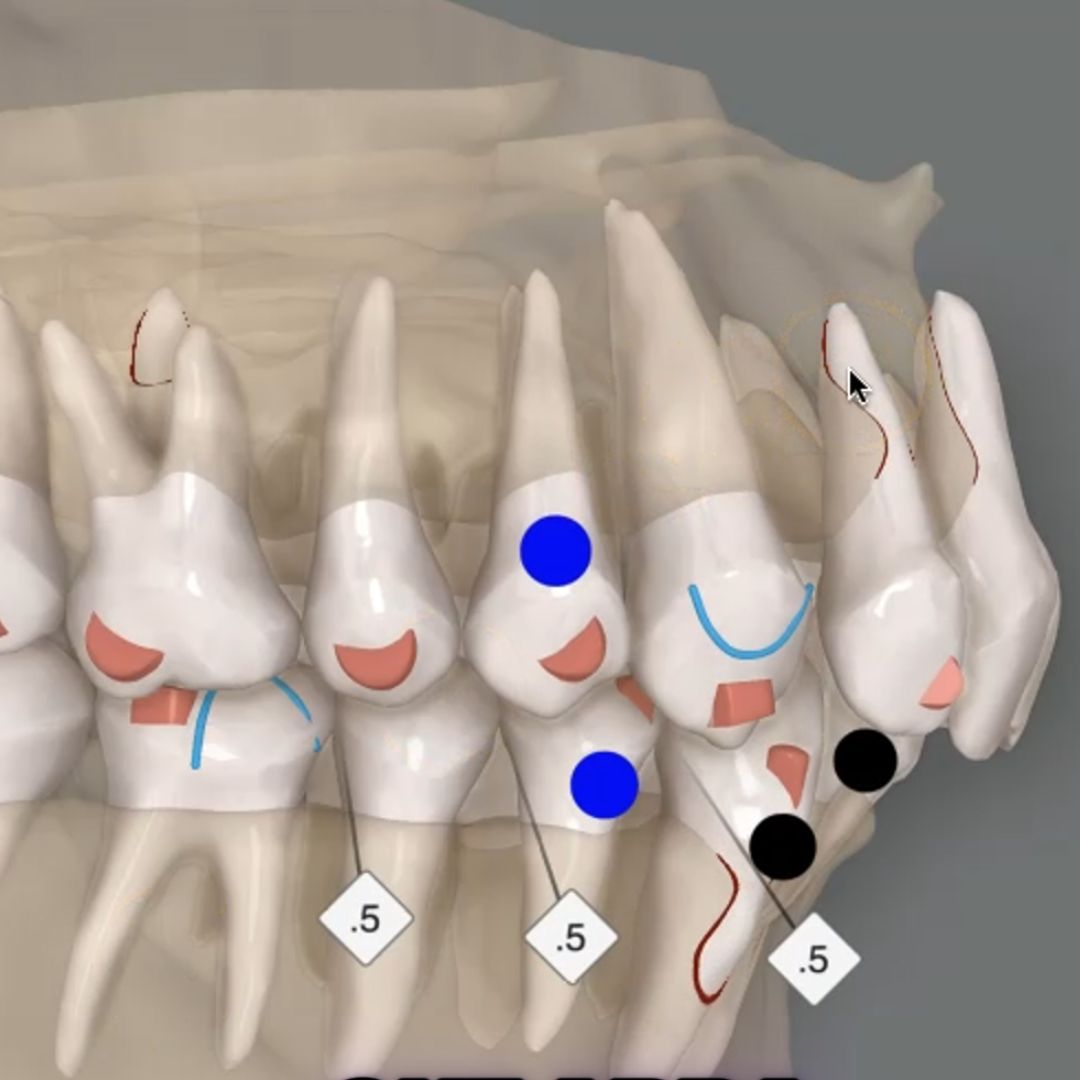
Root torque control is one of the most difficult movements to control in orthodontics, both with fixed appliances and with aligners. In the case of aligners, the issue is often not only the final position of the tooth, but the way in which we attempt to reach it.
In this article we will show you how to do it correctly, although, as always, it can be summarized as follows: control the biomechanics yourself rather than relying on the planning.
Control biomechanics, not the software
Too often we simplify planning by asking the technician for a PIR protocol. The technician executes it, but does so very variably, and that is where problems begin. Not because the aligner does not work, nor because power ridges or attachments are missing, but because the sequence is not biomechanically correct.
A very common mistake is to begin treatment by attempting to deliver radiculo-palatal torque from the outset. At first glance this may seem logical, but it is not. When we request this type of torque at the start, the movement does not express, mismatches appear, and we end up attributing the failure to the system when in reality the issue lies in the order of movements.
When we detect that failure, we sometimes swing to the opposite extreme and request bodily displacement of the entire tooth toward the buccal side. That approach is not correct either. Bodily movement is very complex to achieve with aligners and generates unnecessary resistance that further compromises treatment predictability.
How to achieve torque expression
For torque to express, the sequence must be logical. The first thing we need is to procline the crowns and create space. We must explicitly request that the technician open that space, even if small gaps appear that we can accept. The goal is to prioritize crown movement, knowing that the apex will always move to some extent, both with fixed appliances and with aligners.
After this proclination, it is essential to maintain and consolidate the space. At that point, on the palatal aspect of the incisor root, osseous resistance is no longer the same as at the beginning. The environment has been modified and that completely changes the biomechanical behavior of the system.
It is then, when we retract the incisors, that it makes sense to request radiculo-palatal torque. At that stage, the movement expresses much more efficiently, because we are working with lower resistance from the maxillary cancellous bone and the aligner stops fighting the bone and instead begins working in favor of the mechanics.
Conclusion
The problem is not the software nor the auxiliaries. It is the timing of when we request each movement. The same torque requested in an incorrect phase will not express, whereas, when properly sequenced, it can work very predictably.
Correcting torque with aligners is not about adding more elements or overreacting to mismatches. It is about understanding that we must first create the appropriate biomechanical conditions and then demand the movement. If we try to skip that process, the torque simply will not appear.
As always, advanced knowledge in biomechanics allows us to remain in control at all times, rather than delegating planning to technicians, something that may force us to overcorrect movements later on.
If you want to acquire this knowledge and plan your treatments with confidence while mastering clear aligners, we recommend learning more about our advanced biomechanics system. Optimize your cases to optimize your time and perform more and better treatments each year.
How to close the interincisal diastema after MARPE

Ataches en invisalign: del convencional al optimizado
Attachments: todo lo que necesitas saber


